Grak
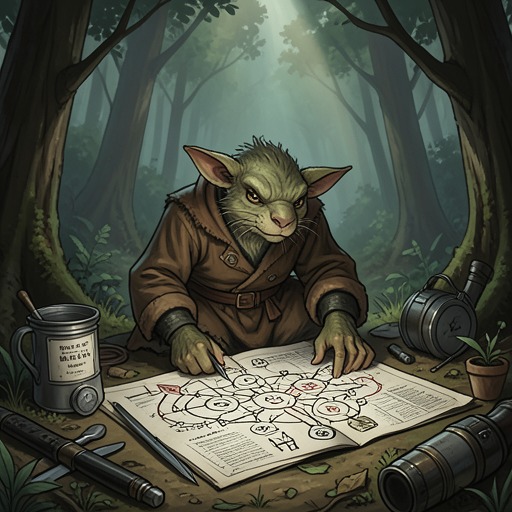
The Legend of William OhGrak is the leader of the kobolds encountered by Will and Travis during the recovery of a Lord’s body. He is defined by a volatile mixture of tactical suspicion, religious enthusiasm, and collective authority: first furious that the Jibleya abandoned a carefully prepared trap, then eager to secure an alliance, and finally willing to place his followers under Loth’s authority when that appears to be the safest and most advantageous course. His allegiance is practical, but his reverence is intense enough to turn a tense encounter into an improvised act of worship.
Identity and Position
Grak is identified as the lead kobold and functions as the spokesman for the surrounding group. The kobolds are armed with spears and communicate in a rough half-speech, but Grak possesses enough initiative to negotiate with outsiders, challenge allied creatures, and direct the reactions of roughly a dozen followers. His leadership is therefore not presented as ceremonial. It is exercised through immediate judgment: he recognizes danger, objects to a ruined ambush, presses for an opportunity, and converts a possible confrontation into a new hierarchy when circumstances change.
His authority also depends on reading status correctly. When the kobolds return to Loth’s castle, Grak is the first to kneel and call Loth the Great One, and the rest of the kobolds rapidly imitate him. The gesture reveals both his influence over the group and his sensitivity to power. The Jibleya leader notices that Will has effectively seized control of half their combined group merely by bringing the kobolds into Loth’s presence. Grak’s response is not to resist the transfer but to embrace it, making submission a means of securing protection and belonging.
The Ruined Trap and the Search for Advantage
Grak’s first prominent action occurs when the kobolds surround Will and Travis beside the Lord’s body. He angrily demands to know why the Jibleya did not wait for the humans to touch the corpse, exposing the trap’s intended trigger and the kobolds’ expectation that greed would draw their targets into danger. The Jibleya explains that the group had nearly discovered their hiding place, so it moved while it still possessed the element of surprise. Grak rejects this justification, accusing the Jibleya of ruining a good trap while keeping his spear trained toward Will.
The disagreement shows that Grak is not merely a subordinate in a mixed hunting party. He has a concrete tactical preference and is willing to voice it under pressure. Yet he does not allow frustration over the failed ambush to become a fixed commitment to violence. When Will suggests that the kobolds and Jibleya could simply leave, the Jibleya leader protests that abandoning the score of a lifetime is impossible. Grak then declares that his people are gods among their kin, even while sharing with berry-people, voicing contempt for the Jibleya’s kind but also confirming that cooperation has already become part of the group’s strategy.
Will immediately reframes the situation by suggesting that they need extra hands. Grak and the Jibleya leader exchange a look and reconsider their position. Grak’s conduct here is characteristic: he begins from territorial aggression, but he can recognize a better arrangement when it promises greater returns. The failed trap does not end the encounter; it becomes the opening negotiation for a new partnership.
Submission to Loth
Once Will guides the group back to the Lord’s castle, Grak’s behavior changes with startling speed. He grovels before Loth and cries out to the Great One, followed by the other kobolds. The Jibleya are confused by how completely the kobolds reverse their attitude, but their leader understands the political reality: Will has captured half the group’s loyalty, and refusing to follow would risk conflict. Grak’s submission is thus both sincere and strategically useful. He identifies Loth as a figure whose authority can reorganize the group, then publicly establishes that recognition before his followers.
Grak also recognizes Loth’s difference from ordinary humans. Will points out that Loth is several inches taller than the tallest kobold, has an unusual color, is highly educated, and repeatedly discusses philosophy while Will is trying to sleep. Compared with the kobolds’ limited vocabulary, these traits make Loth appear exceptional. Grak responds by begging Loth to grant the group the honor of forming a new clan. The request converts admiration into an institutional proposal: the kobolds do not merely want to follow Loth temporarily; they want a recognized collective identity under his protection.
Loth refuses, saying that such a clan will not be formed. Grak answers that he would gladly die for it, turning the negotiation into exaggerated devotion. The exchange captures the tension in his character. He is opportunistic enough to change sides when power shifts, yet demonstrative enough to treat political incorporation as a sacred privilege. His loyalty may originate in calculation, but he performs it with absolute enthusiasm.
Managing Devotion and Violence
The relationship between Grak’s followers and Loth becomes dangerous when Will attempts to touch Loth’s head. Loth warns that Will does not touch him, and the kobolds interpret the offense as requiring punishment. Loth explains to them, in their own half-speech, that the stupid human does not understand what he is doing and that head-patting is a form of affection among humans. He promises that Will will not do it again.
Grak immediately escalates the matter, shouting that the kobolds must ensure it never happens again and calling for Will’s hand to be taken. The surrounding kobolds join the cheer and shake their spears, demonstrating how quickly Grak can turn personal reverence into collective violence. His instinct is not to investigate intent or accept a social explanation; it is to defend the revered figure through exemplary punishment. Loth’s flat refusal stops the escalation, but the scene establishes Grak as a leader whose protective loyalty can become lethal before a higher authority reins it in.
This moment also clarifies the limits of Grak’s obedience. He will submit to Loth, but submission does not make him passive. He continues to interpret threats and prescribe responses on Loth’s behalf. Loth must actively restrain him, refusing the offered violence rather than merely assuming that Grak will understand the boundary himself.
Watcher in the Ruined City
Grak remains part of the group sheltering in the rafters of an abandoned house as the smoke-reddened sun rises and the Tangled emerge into the streets. The kobolds do not dare move or even breathe while waiting for the monsters to reveal themselves. Grak serves as the lookout, whispering that the Tangled is coming and pointing with a claw.
His warning sustains the scene’s suspense because the threat initially appears in an unexpected form: what emerges is not an immediately recognizable beast, but a naked young man about Will’s age, stumbling vacant-faced through the street. Grak’s warning is therefore accurate without being explanatory. He detects the arrival of danger, but the identity and nature of that danger remain uncertain to Will and the others. In this role, Grak is both a practical sentry and a participant in the story’s delayed revelation of the Tangled.
Across these encounters, Grak’s importance lies less in independent transformation than in the way he makes group behavior visible. He turns a failed ambush into negotiation, a change in power into worship, an insult into a potential execution, and an unseen movement into a whispered warning. His recurring function is to translate danger into collective action, making him the kobolds’ clearest representative and one of the principal mechanisms through which their volatile alliance enters the plot.